



Week 1: Seven Classic Hollywood Era Christmas Films
While I am a big enough fan of movies that I will from time to time call myself a Cineaste, I’m also what I like to call “pretentiously anti-pretentious.” If you’ve read this newsletter for some time, you might have some idea of what I mean by that. I like movies as both entertainment and as art, but I dislike those who like things only “because they are supposed to” or because they are being “ironic.”
As I mentioned in my response to Luke Y. Thompson’s Sunshine Award questions, I do believe that there are objectively great movies. I also believe that people should like them because they are actually good and not because they are supposed to like them. I’ll too often see a modern critic complain about a more recent movie being saccharine or predictable with one breath, while praising an equally saccharine or predictable film with the next. The only difference between the two films is that one is older an on the “list of films you are supposed to like” and the other is more recent.
Sorry those of you who think “The Author is Dead” and that “All Art is Subjective,” there are objectively good and objectively bad movies. That doesn’t mean that you have to like them or hate them. I can appreciate that the best professional golfers in the world are objectively good at golf, but I don’t like golf so I don’t like watching people play it. Sometimes films that are well written, expertly edited, exquisitely acted, and look beautiful don’t connect with a viewer. That’s fine.
On another note, I don’t believe it’s possible to “like something ironically.” Either you like it, which is cool, or you don’t like it and are claiming to do so. Now claiming to like something you don’t is an ironic thing to do, but you don’t like it ironically. You might be liking it just to annoy other people and there’s a different turn of phrase for that than being ironic. I might be willing to concede something like a Richard Rorty-esque understanding that you can like something while believing there is no grounds for liking it except your personal preference.
Rorty loved Liberal Democracy, but he believed his love was nothing but personal preference and that there were no objective standards to base his preference on. Genuinely valuing an ideology/belief system while thinking there are no real moral foundations is actually irony, there’s a reason he called his philosophic school Ironism, but he genuinely loves Liberal Democracy. To “ironically” like something is to like it while knowing that’s an indefensible position, but that’s not “liking it ironically” it’s that it’s “ironic that you like it.” That’s a distinction with a difference, one of temperament.
This is one of the reasons I like Quentin Tarantino as a film maker and commentator is that he is sincere in his opinions. He likes what he likes and dislikes what he dislikes, and his reasons re typically consistent. I’ll often disagree with him in his selections, for example his love for Lost in Translation is not one that I share, but I have no doubt that his selections are completely unironic and rooted in what he actually enjoyed or learned from as a film maker. Yes, I’ll rolled my eyes when the man who riffed on Ringo Lam’s City on Fire when he made Reservoir Dogs says that the makers of Battle Royale should sue Susan Collins. She added enough new elements inspired by Shirley Jackson’s “The Lottery,” Aldous Huxley’s Brave New World, and Stephen King’s Running Man to claim her story is unique. Hunger Games is far more libertarian than Battle Royale and lacks that film’s commentary on how society demonizes the next generation and places young people under unreasonable pressure to succeed. Battle Royale is a kind of an inverse Wild in the Streets and this critique is even stronger in the novel. My eye roll wasn’t about Tarantino’s pretense though, it was at his lack of self-reflection in how he approaches the craft as a maker rather than as a critic. In my view Tarantino’s film tastes are those of the old school “local video store clerk” who actually liked movies and was equally likely to recommend My Dinner with Andre as Predator 2, as opposed to the Blockbuster video store employee who only liked the right movies.
Wow, that’s a lot of words taken up to say that this will be a straightforward list of recommendations that will be films I genuinely like. This will be true as the we travel through the Christmas Season on our Christmas Movie Advent-ure Marathon. My selections will be those that push back against the Blockbuster clerk style critic, and there are plenty of those working at Indiewire and Variety, and will be more along the lines of Tarantino’s list with hopefully a tad more self reflecton.
So that means that in one of the next three weeks you might just see Die Hard among the recommendations. If I do include it, I will explain why it actually belongs in the genre and is a very typical example of the subgenre I’ll be sharing a lot of today. I will not be doing it to be ironic or edgy in the manner that so many of those online who say it’s a Christmas film are doing. I hate it when they do that. Die Hard isn’t a Christmas film because it takes place at Christmas time, one of the films I am recommending today has a Christmas scene but most takes place outside of Christmas season, but because it genuinely contains the Christmas Spirit. So too does Lethal Weapon, but that’s a discussion for Week 3.
This week’s selections are all genuine classic Christmas films that I deeply love. I think many of them are overlooked because they were released a long time ago and might be overlooked with the abundance of excellent Christmas films that have been made over the intervening decades.
Let’s Feel the Christmas Joy: Here’s the Week 1 List.
1) It Happened on 5th Avenue (1947)
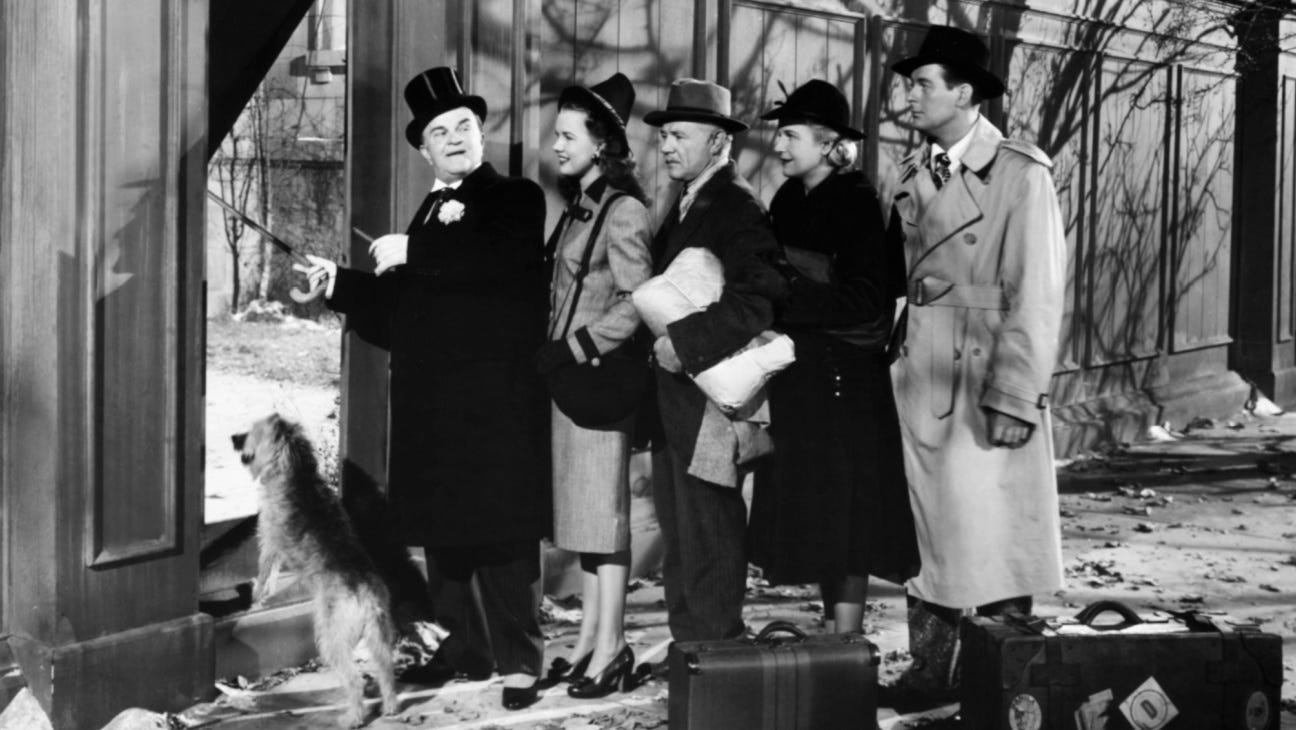
Frank Capra was originally slated to make It Happened on 5th Avenue for Liberty Pictures, but he decided to direct the box office flop It’s a Wonderful Life instead. It never ceases to amaze me that it was the fact that It’s a Wonderful Life (minus the score) dropped temporarily into the Public Domain in 1974, allowing it to be broadcast on the cheap, that led to it becoming a seasonal classic. After Capra moved on from the project Roy Del Ruth came in as Producer Director, a mildly surprising choice to me given that crime films and proto-noir had made up so much of his early career though he had worked on some upbeat stories.
It Happened on 5th Avenue seems a film perfectly suited to Capra or Preston Sturges as it deals with the issues of class. It’s also very much a quintessential 1947 film dealing with the neglect many veterans of WWII experienced after returning home. While this is an entirely upbeat film, it was released a year after films like The Best Years of Our Lives and The Razor’s Edge. The direction style falls somewhere between Sturges and Capra. It’s Sturges in that there are no villains in the story, but it’s Capra in that there is a genuine struggle about housing and the responsibility of people to come together. It’s a wonderful film that captures the spirit of charity perfectly.
2) The Shop Around the Corner (1940)
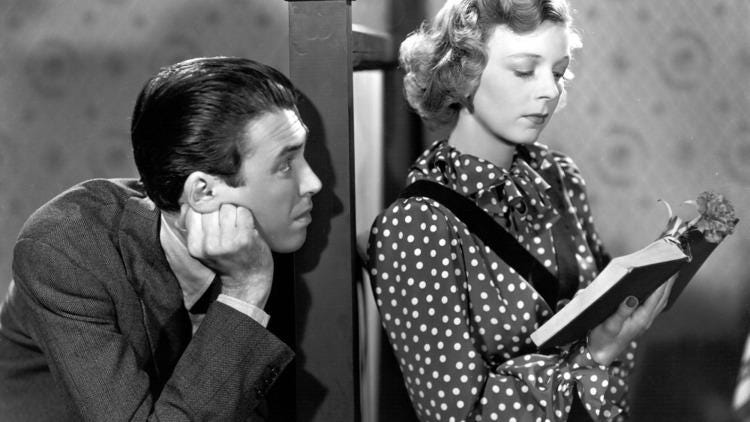
The Shop Around the Corner is one of the most romantic films ever made and it is one of the best films to watch in the Christmas season. The film has been remade several times with classics like In the Good Ol’ Summertime and You’ve Got Mail. Each of those classics addressed the one minor flaw in the original, that the reconciliation in the final act comes too quickly, but both lack the one thing that makes The Shop Around the Corner slightly better. While the central conceit of the film is that two pen pals are madly in love with each other in writing and hate each other in person, that is only one of the ways that this particular telling portrays love. The later films focus on the Beatrice and Benedick romantic centerpiece, with it’s quippy and witty dialogue, this film uses those as a brilliant counterpoint to the more subtle love around them.
There’s the love of Pirovitch for his wife and young child that is used as a part of a wonderful “glass slipper” moment in the film. There’s the love of Pepi Katona for the businessman who has given him opportunity. We don’t know his exact backstory, but we imagine it is similar to that of Rudy the boy he chooses to replace him as delivery boy by the end of the film. There is the love of Flora for Mr. Matuschek. It’s a love that Matuschek almost notices at the end and is very subtle, but is there intentionally. Which is likely one reason why Robert Z. Leonard had the two equivalent characters get married in In the Good Ol’ Summertime. There is the “love” of Vadas and Mrs. Matuschek that is a commentary on envy and the importance of real love in a marriage. Finally there is the fatherly love between Kralik and Matuschek.
This is a film that oozes love. Love is, as the voice over of Love Actually states at the end, all around. All three of the major versions of this film are regular staples in my annual viewing. They are all true classics, but Jimmy Stewart and Margaret Sullavan have such great chemistry together. It’s no wonder that Ernst Lubitsch rescheduled the shooting of the film to ensure they could both star in it.
3) The Thin Man (1934)

When people discuss, seriously, whether Die Hard is or isn’t a Christmas film, I always ask them to watch The Thin Man and tell me whether they think it is a Christmas movie. To me it is an almost perfect Christmas film. It’s about a new marriage that encounters a significant challenge as one of the partner’s pasts comes into conflict with relatively newlywed bliss. It’s about charming people, deeply in love, solving a murder and saving a family. The novel by Dashiell Hammett is wonderful, but dark and a bit angry. Hammett, who had been a Pinkerton Union Buster, had little faith in humanity. When my wife and I visited friends in Montana in 2021, we drove past the Anaconda mine where Dashiell worked and then quit the Pinkertons. It was a beautiful and stark place that would have been even starker in the Teens and Twenties.

This film manages to keep the dark undertones while keeping its faith in humanity. The Nick and Nora of the film, and its sequels, are much closer in their interactions and love for one another to screenwriters Albert Hackett and Frances Goodrich than to the relationship between Hammett and Lillian Hellman that inspired the book characters. They are a couple in love who could bicker, worry, and tease while never losing sight of how much they cared for one another. The movie has a good use of forensic pathology and in solving the case Nick and Nora fall deeper in love and save a younger couple from destroying their relationship. The “meaning of Christmas” stuff comes with the interactions Nick has with people from his past and in the triumph of love.
4) Going My Way (1944)
Going My Way is a beautiful film about faith and love that has one of the most powerful final moments I’ve ever seen in film. The basic premise for the film is that St. Dominic’s Church in New York City is struggling under the leadership of its elderly pastor Father Fitzgibbon and young priest Father Charles “Chuck” O’Malley has been sent to save the diocese from ruin. Fitzgibbon assumes that O’Malley has come to push him aside and take his place as the new pastor for the church and this sets the stage for the underlying conflict.
O’Malley and Fitzgibbon represent two different pastoral approaches with O’Malley being closer to Pope Francis and Fitzgibbon closer to Pope Benedict in how they react to sin and sinners. While a shallow reading of the film might assert that O’Malley’s approach is always the right one, such readings overlook the influence that Fitzgibbon’s faith and sacrifice have on O’Malley. This is a film with no villains and the only proper pastoral approach being presented is one of love. O’Malley uses the church choir as a way of redirecting the youth of the parish away from criminality and toward charity and community. While the choir story would dominate a modern version of the tale it is merely one of many storylines here, though it does happen to be the one that culminates in a perfect ending.
**** SPOLER ALERT ****
Once O’Malley has gotten the church’s finances stable, Fitzgibbon realizes that he will finally be able to return home to Ireland to see his ancient mother, a woman he hasn’t seen in 45 years. Sadly, an accidental fire damages the church putting things in chaos again. Not so much that it will have to close, but enough that Fitzgibbon will not be able to go home. The film ends with O’Malley having the choir sing “Too-ra-loo-ra-loo-ral” as he sneaks Fitzgibbon’s ancient mother into the makeshift church. As Fitzgibbon sees his mom and goes over to hug her, O’Malley walks off into the distance knowing it’s a job well done. I’ve rarely cried so hard at the end of a movie and the fact that the 1992 Steve Martin and Goldie Hawn film Housesitter references this scene makes it even more powerful.
5) Christmas in Connecticut (1945)
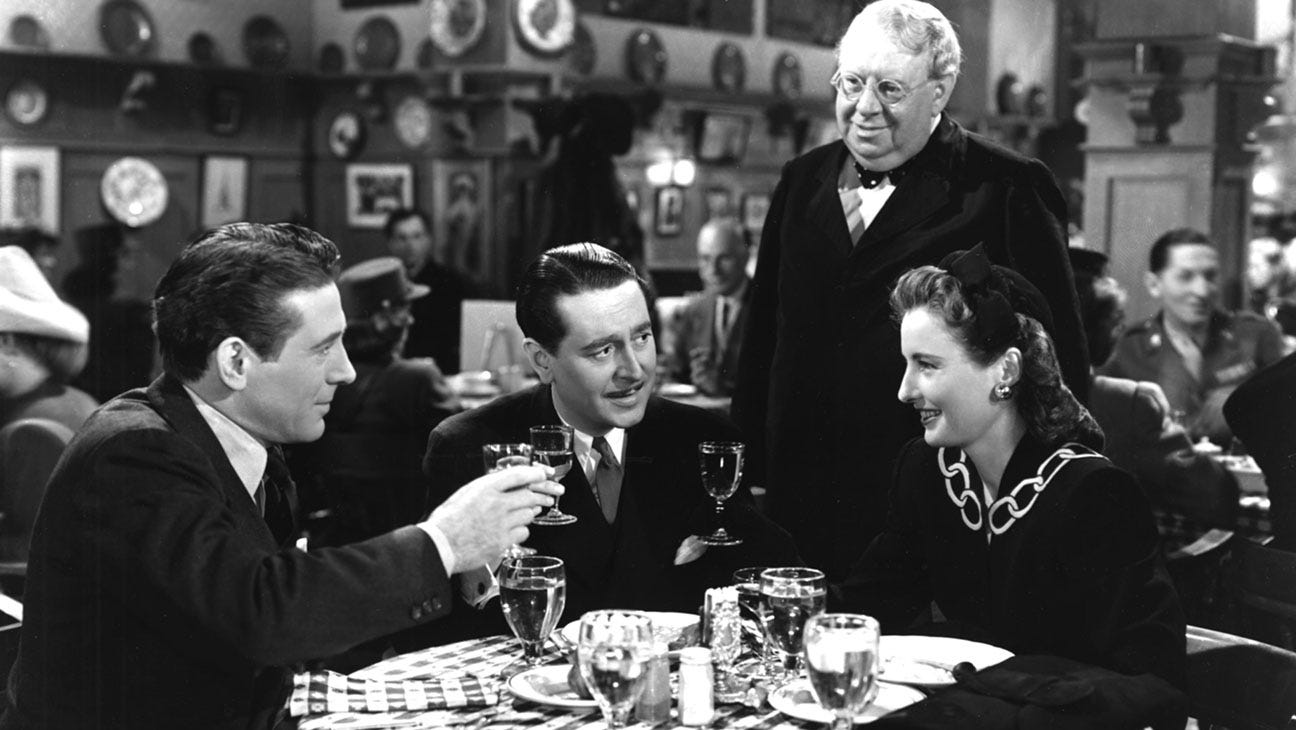
Barbara Stanwyck, Dennis Morgan, S.Z. Sakall, Sidney Greenstreet, and Reginald Gardiner star in a charming romantic comedy that combines sincerity with a touch of slapstick and farce. It’s rare for an American film to push farce in the way that French films do, though when it does you end up with wonderful comedic experiences like Noises Off and Clue. There is a wonderful bit in the film when Felix (S.Z. Sakall) is teaching Elizabeth (Barbara Stanwyck) how to flip pancakes and another with a missing baby that are delightfully silly, but at its root this is a serious film about real love and a real love match.
Stanwyck plays Elizabeth Lane, one of the most successful family home advice columnists in media. She’s essentially the Martha Stewart of her age and her publisher adores her. She has been working hard and wants a raise. Somehow these two tensions combine with Elizabeth inviting her publisher to her farmhouse in Connecticut for Christmas dinner. The problem? She doesn’t have a farmhouse in Connecticut, but John Sloan (Reginald Gardiner) does and he is madly in love with Elizabeth. Given that Elizabeth is played by Barbara Stanwyck, this is not a stretch of the imagination. Had the film kept Bette Davis, who was originally cast as Elizabeth, this might not have worked so well.
This sets up a delightful game of cat and mouse where Elizabeth and Sloan are going to be married, except for one small wrench in the works. Sloan has agreed to house a wounded veteran in his home for the holiday, and Elizabeth is far more attracted to him than Sloan. There are a lot of jokes that could have been over played here, but none are and everyone ends up happy in the end. While some critics have tried to imply that this film was pushing a conservative ideology to get women back into the kitchen, such critiques are shallow and ignore the resolution which is that Elizabeth gets not only a raise but a promotion and will never be headed to the kitchen.
6) The Awful Truth
While Cary Grant and Irene Dunne only made three movies together — (take that emdash AI) if you count Dunne’s Holiday Affair and Grant’s An Affair to Remember they made four of the same film but only three actually together — but the three they made are all masterpieces. All three of them are “remarriage films” of a sort. The Awful Truth tells the story of a young couple adjusting to married life who don’t yet fully trust one another, and who are still hiding small things from one another. My Favorite Wife takes place in the middle of an established marriage where the couple are separated for years while the wife is stranded on a desert island, only to return after seven years to a husband who has just remarried. The final film is a tremendously melodramatic film in which the couple has to face the tragic death of their only child. The death causes them to question why they are together and whether they truly love one another.
Each of these films takes place at least partly at Christmas, and being remarriage films are filled with very Christian messages about marriage and family and all of the obligations of the sacrament of marriage. You see, in the Catholic (which Irene Dunne was) and Orthodox traditions Marriage is one of the Seven Sacraments and is one of the outward visible signs of God’s love for humanity and the Church. Healing a damaged marriage is a revalidation of that sacrament and thus any film that celebrates that is by its very nature a Christmas film from the perspective of having a Christian message (or at least “Christian approved”) message. Not all Christmas films need to be about The Little Drummer Boy or the Magi, they can be about love and family too and the best Christmas movies tend to be about charity and love.
For me, it’s best when these films share a message of love without being overtly Christian. I find more beauty and grace in a film like The Thin Man, than I find in a film like God’s Not Dead. I don’t write much about religion here, I’m not a religious blogger and have no desire to be a religious or political blogger of any kind, but I think that when one is talking about what makes a movie a Christmas movie or not that it’s okay to bring in a little religious reasoning why you think a film fits the bill. Just to warn you, when I defend Die Hard and The Last Boy Scout in a couple of weeks you’ll here some of these same arguments being made.
Back to the film at hand though. I could have chosen any of the three Grant and Dunne films — and unlike Orson Welles I adore Irene Dunne — but I have a special place in my heart for The Awful Truth. It’s the zaniest of the films. Where My Favorite Wife has the best balance of comedic and dramatic acting, The Awful Truth really puts itself out there with attempts at humor and pushes the censorship of the era to the limits. It is very much a Code Era film, but the song at the club, Dunne’s reperformance of it later, and the final scene push the Code pretty far.
If you want to know why Cary Grant was a movie star, The Awful Truth is the best film to answer that question. He is beautiful, charming, and witty, but he is also a magnificent physical comedian who performs physical bit after physical bit in this movie to wonderful effect. My favorite scene in The Awful Truth is the “hat scene” and it demonstrates Grant’s command of the medium, a medium that was still fairly young at the time.
7) Miracle on 34th Street (1947)
I was sitting on the couch with my daughter History on Thanksgiving morning and watching the Macy’s Thanksgiving Day Parade when I decided to be a bit sneaky and start up Miracle on 34th Street starring Maureen O’Hara, John Payne, Edmund Gwenn, Gene Lockhart, and a very young Natalie Wood. It’s quite the cast and there are a number of cameos as well tht make the film quite wonderful. History was sick and so I knew I had her a bit trapped. Neither History or Mystery have much appreciation for films “from the 1900s” and so I had knew I had to take advantage of this opportunity to share an immortal classic with her.
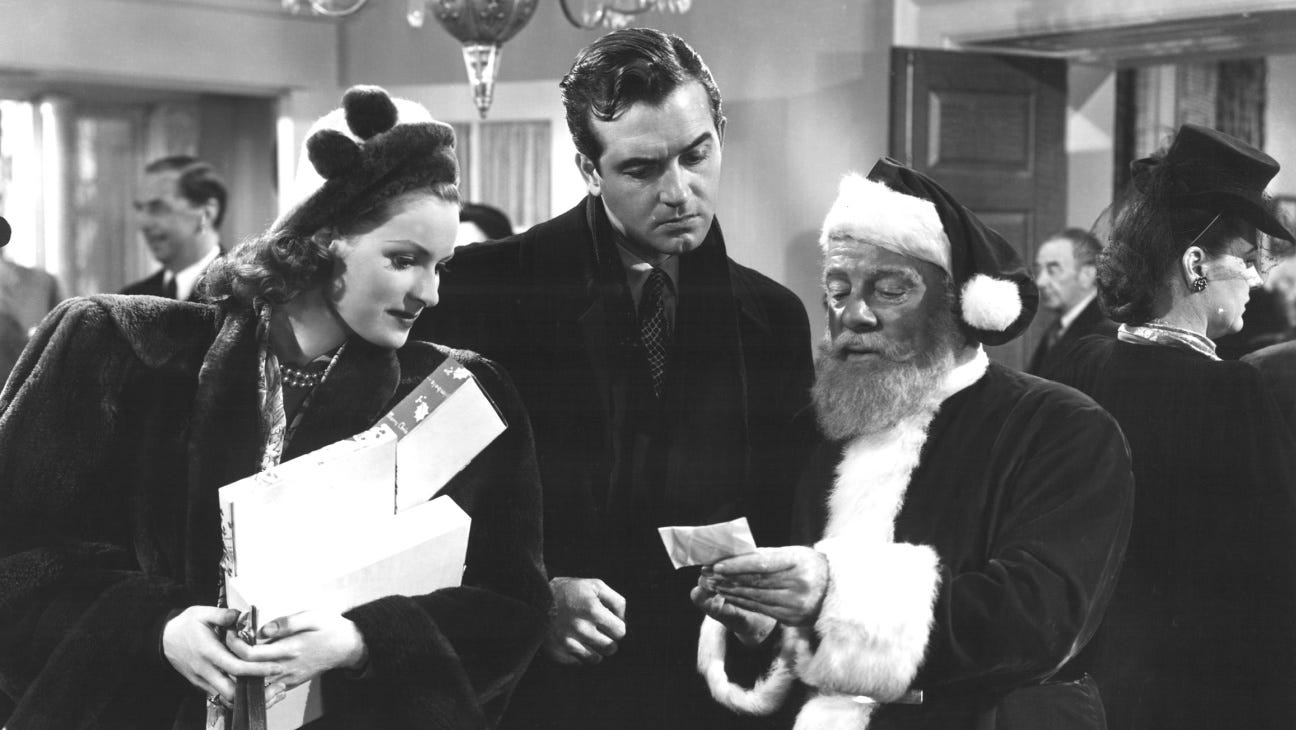
The story is very simple. The real Santa Claus finds himself working at Macy’s during the Christmas season and makes it his mission to persuade a young unbelieving girl and her skeptical almost to the point of cynical mother that he is the real Santa Claus. Natalie Wood is fantastic as the incredulous youth and Maureen O’Hara may not be able to completely hide her Irish accent, but she is able to run the full gamut of emotions believably and wonderfully. John Payne, who is also known for his work in film noir, is charming in the movie as the neighbor who is interested in dating the mother (yes, this is a romantic comedy) and Edmund Gwenn is perfect as Kris Kringle. Character actor extraordinaire (who is in one of the best versions of A Christmas Carol and the is the grandfather of Sheeba in the original Battlestar Galactica) Gene Lockhart plays the judge who gets to decide if Kris Kringle is really Santa Claus or if he needs to be committed.
It’s a film about faith, but not of the religious kind. It this case it’s about having faith in one another and more importantly it’s a film about love. It has one of the most touching moments in cinematic history when — and remember this is 1947 — Santa Claus talks with a young Dutch girl who is a refugee in the United States after World War II. When Santa asks her what she wants for Christmas, and to paraphrase her, she says “Nothing, I just want to stay with this kind woman.” By the time this scene came around History was all-in and wasn’t complaining about watching a film from the 1900s.
Thank you for acknowledging both Die Hard and Lethal Weapon as Christmas films.
I assume you'll cover Gremlins as well.